
6 skincare myths that unnecessarily complicate your routine
Skincare advice is everywhere. One day a facial oil would save your skin, the next day that same oil would clog your pores. You supposedly need ten steps for a healthy glow, but at the same time, “skinimalism” is also being promoted. And dark circles? They would simply disappear as soon as you get enough sleep.
The truth is usually more nuanced.
Your skin does not react to trends, but to the composition of a product, the amount used, your skin type, and how consistently you follow a routine. Time to take a closer look at six stubborn skincare myths.
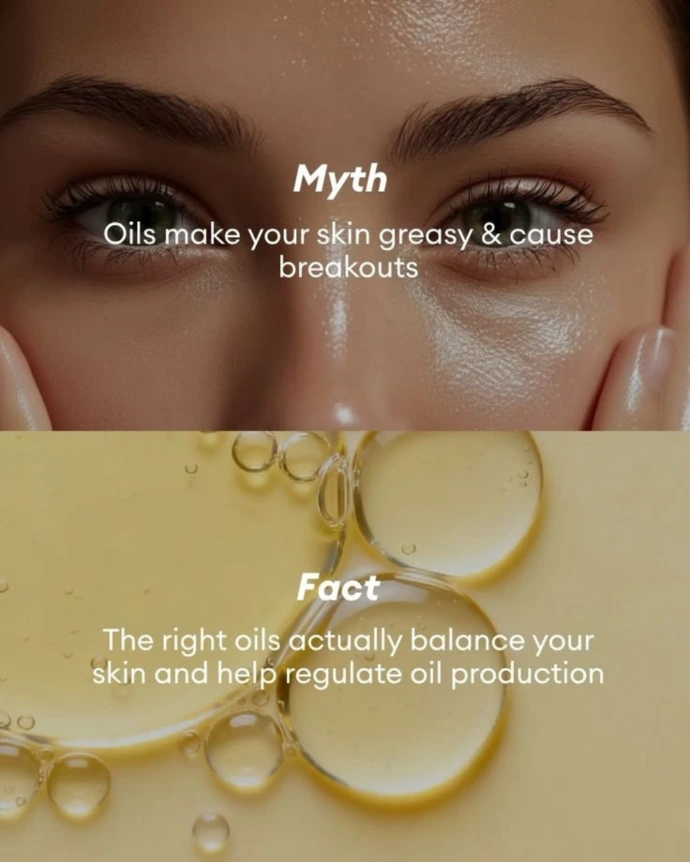
Myth 1: “Facial oil makes your skin oily and causes breakouts”
The truth: not every oil behaves the same
The word oil is often treated as one large category, while there are huge differences between botanical oils. They each have a different composition of fatty acids, antioxidants, and other skin-nourishing ingredients. As a result, they can also feel and react differently on the skin.
Certain plant oils can support the skin barrier, soften the skin, and help to reduce moisture loss. However, that does not mean that every oil is automatically suitable for every skin type. A heavy or highly occlusive formula may be less pleasant for someone with acne-prone skin and can, in some cases, exacerbate comedones. Therefore, the complete formula is more important than the simple label “with natural oil”.
Why does oil sometimes feel greasy?
Oil contains no water. It does not hydrate the skin in the same way as, for example, glycerin or hyaluronic acid. An oil primarily works to soften and helps to retain the moisture that is already present in the skin.
If you use too much, a noticeable film will remain. That does not necessarily mean that the oil is “bad”; it may simply mean that you have applied more than your skin needs.
Practical tip: start with two to three drops and apply them to slightly damp skin or over your moisturizer.
And for impure skin?
If you have quickly clogged pores or active acne, choose carefully. Dermatological guidelines generally recommend light, non-comedogenic, or oil-free products for acne-prone skin, as some oil-rich cosmetics can exacerbate comedones.
A facial oil is therefore not necessarily your enemy, but it is also not a mandatory step for everyone.
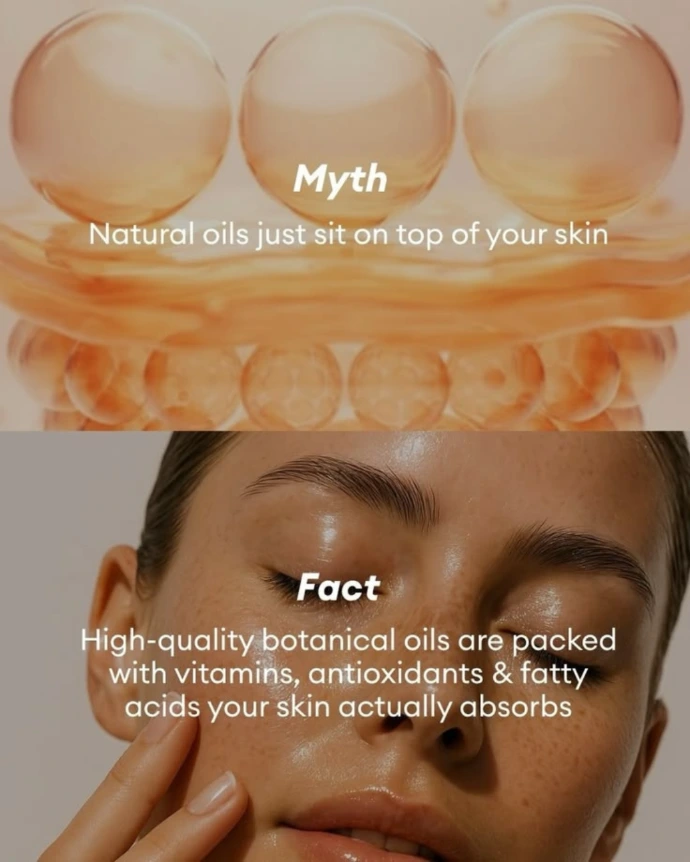
Myth 2: “Natural oils just sit on top of your skin”
The truth: partially - and that is not necessarily negative.
The outermost layer of skin, the stratum corneum, is designed to keep substances out. Not every ingredient therefore penetrates deeply into the skin. Many cosmetic oils largely remain in or on the superficial layers of the skin.
But it is precisely there that they can be useful.
An oily layer reduces water evaporation, fills spaces between dry skin flakes, and makes the skin surface smoother and more supple. Some components from oils can also penetrate to a limited extent into the upper layers of the skin. How this happens varies greatly depending on the oil, fatty acid composition, and formulation.
“Staying on the skin” does not mean “doing nothing”
Think of a coat. It doesn’t need to penetrate your body to protect you from the wind. In the same way, a nourishing film on the skin surface can help to limit moisture loss and support a vulnerable skin barrier.
This makes botanical oils particularly interesting for dry, tight, or dull skin. For very oily or acne-prone skin, a lighter formula may be more comfortable.
The quality of an oil is therefore not determined by how deeply it penetrates, but by what it does at the place where the skin needs it.
Myth 3: “Dark circles are only caused by lack of sleep”
The truth: dark circles often have multiple causes
After a short night, dark circles may be more visibly apparent. That does not mean that lack of sleep is always the underlying cause.
The colour and shadow under the eyes can be related to:
- genetic predisposition;
- a thin, transparent skin;
- visible blood vessels;
- increased pigmentation;
- eczema, allergies or frequent rubbing of the eyes;
- fluid retention;
- volume loss or a deeper tear trough, creating shadow.
Dark circles are therefore not a separate skin condition with one standard solution. What looks like pigment may actually be primarily a shadow. And what appears to be fatigue may be genetically determined.
So what can eye care actually do?
A well-formulated eye product can hydrate the skin, make it appear temporarily smoother, and keep the delicate eye area comfortable. Ingredients aimed at pigmentation, swelling, or the skin barrier can provide support depending on the cause.
But no eye cream can completely change your anatomy or genetic predisposition. Therefore, realistic expectations are important.
Extra important: treat the eye area gently. Rubbing and pulling hard can exacerbate irritation and post-inflammatory discolouration.
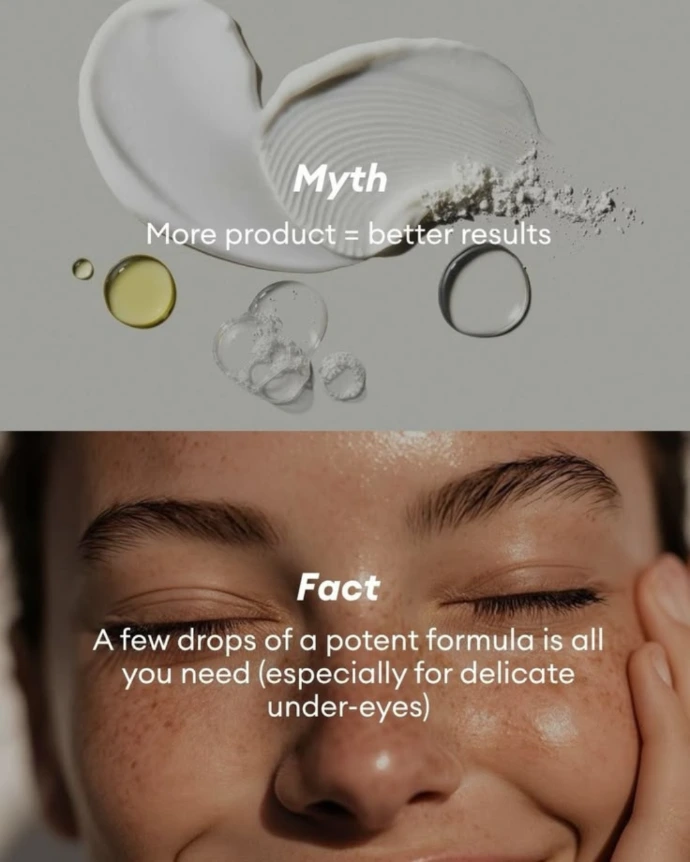
Myth 4: “The more product you use, the better the result”
The truth: your skin does not benefit from excess
A double amount of serum usually does not yield double results. Cosmetic formulas are developed to be evenly distributed over the skin in a certain amount.
Applying more can lead to:
- a sticky or heavy skin feel;
- products that roll or pill;
- unnecessarily rapid product consumption;
- increased risk of irritation with potent active ingredients.
Especially with retinoids, exfoliating acids and other intensive actives, “more” is not automatically “better”. Combining too many different active ingredients can actually make the skin more sensitive, drier or red.
Dermatologists also advise to build up skincare purposefully and to first focus on one important skin need. This way, you can better assess what works and reduce the chance of irritation.
How much do you need then?
That varies by product and packaging. As a general guideline:
- a small amount of eye cream for the entire eye contour;
- a few drops of serum for the face and neck;
- enough moisturizer to make the skin feel comfortable;
- with sunscreen, use enough to achieve the indicated protection.
SPF is therefore the exception where applying too little directly reduces protection. A broad-spectrum sunscreen with at least SPF 30 remains one of the most important steps to help prevent premature skin aging from UV radiation.
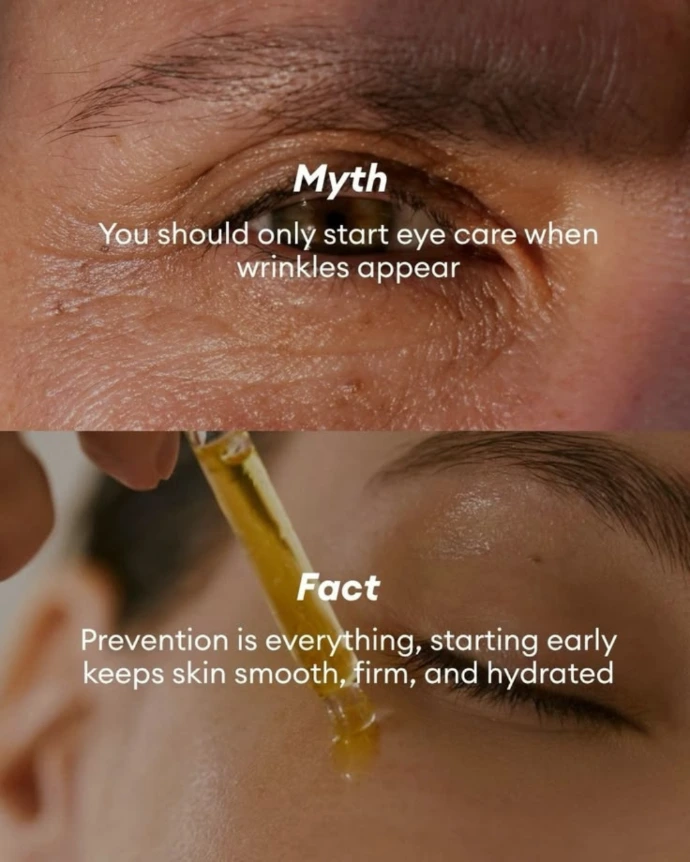
Myth 5: “You only need to start eye care when you get wrinkles”
The truth: care is also about prevention and comfort
You don’t have to wait for visible wrinkles to pay attention to the eye area. The skin around the eyes is thin and can feel dry or sensitive more quickly.
Early eye care does not mean that someone in their twenties needs an aggressive anti-aging routine. It’s mainly about simple habits:
- gently cleansing the skin;
- adequately hydrating;
- not rubbing hard;
- using daily protection against UV radiation;
- to wear sunglasses in bright light.
Chronic UV exposure accelerates visible skin ageing and contributes to wrinkles, pigmentation spots, and loss of firmness. Daily sun protection is therefore often more important than the most expensive eye cream.
Does everyone need a separate eye cream?
No. A gentle, fragrance-free face cream can be perfectly used around the eyes for some people, as long as it does not sting or irritate.
A separate eye cream is particularly interesting when you prefer a lighter texture, quickly suffer from sensitive eyes, or want to specifically address issues such as hydration, fine lines, or puffiness.
Eye care is therefore not a mandatory extra jar. Gentle, consistent care is the real starting point.
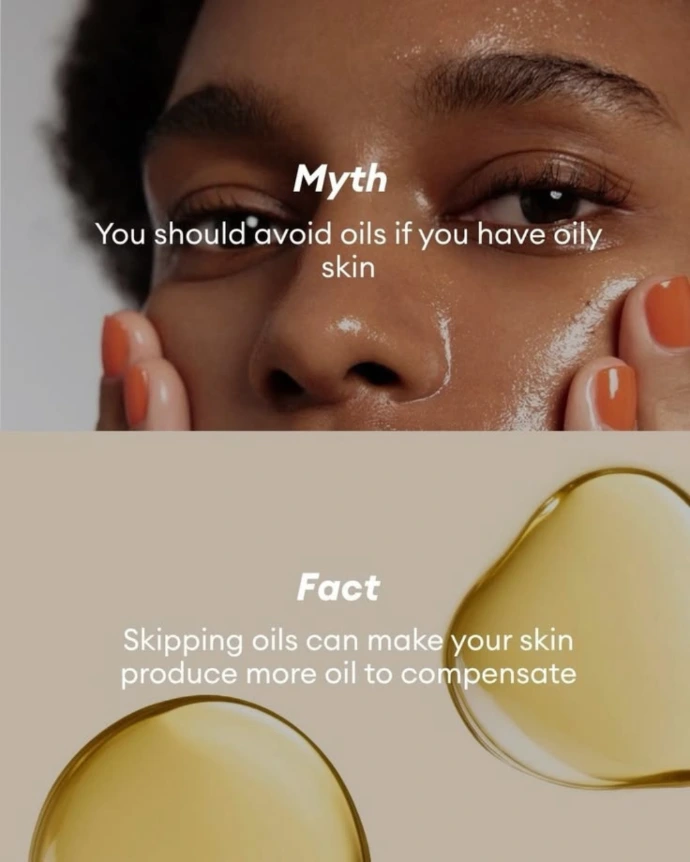
Myth 6: “With oily skin, you should avoid all oils”
The truth: oily skin and a well-chosen oil do not automatically exclude each other.
Oily skin produces more sebum. That is something different from applying a cosmetic plant oil. Sebum is produced by the sebaceous glands and consists of a specific mix of lipids. A facial oil mainly sits on the skin's surface and has a different composition.
That does not mean that every oily skin needs oil. It does mean that “oil” does not automatically equate to “more sebum”.
Moreover, there is insufficient evidence for the popular claim that your skin will produce extra sebum as soon as you stop using facial oil. Sebum production is primarily influenced by genetics, hormones, and the activity of the sebaceous glands.
When can an oil still be suitable?
A small amount of a light, well-formulated oil can be pleasant when an oily skin is simultaneously dehydrated, tight, or irritated. For example, when intensive acne products dry out the skin.
If you easily have comedones or inflammations, be more cautious. Choose non-comedogenic formulas, introduce one product at a time, and observe how your skin reacts. For persistent or severe acne, professional dermatological advice remains the best choice.
The correct conclusion is therefore not: “an oily skin needs oil.”
But also not: “an oily skin should never use oil.”
The formula and your individual skin reaction determine what is suitable.
What can we learn from these myths?
Most skincare myths arise because a nuanced story is reduced to one simple rule:
Oil is bad. More is better. Dark circles mean you are tired. Anti-aging only starts when you see wrinkles.
But skincare rarely works in such black and white terms.
A smart routine does not have to be long. It should primarily suit your skin:
- Cleanse gently.
- Treat specifically what you want to improve.
- Hydrate and support your skin barrier.
- Protect every day against UV radiation.
- Give new products enough time and do not change everything at once.
Listen less to absolute rules and more to what your own skin shows. Because the best skincare is not the routine with the most steps, but the routine that your skin tolerates well and that you can consistently maintain.
Discover which Tinge products meet your skin needs
From light hydration and targeted eye care to botanical oils and daily sun protection: create a simple, thoughtful routine on our website that truly suits your skin.