The role of astaxanthin in skin health
Some ingredients suddenly appear everywhere. Not because they are new, but because we are gradually beginning to understand them better. Astaxanthin is a good example of this.
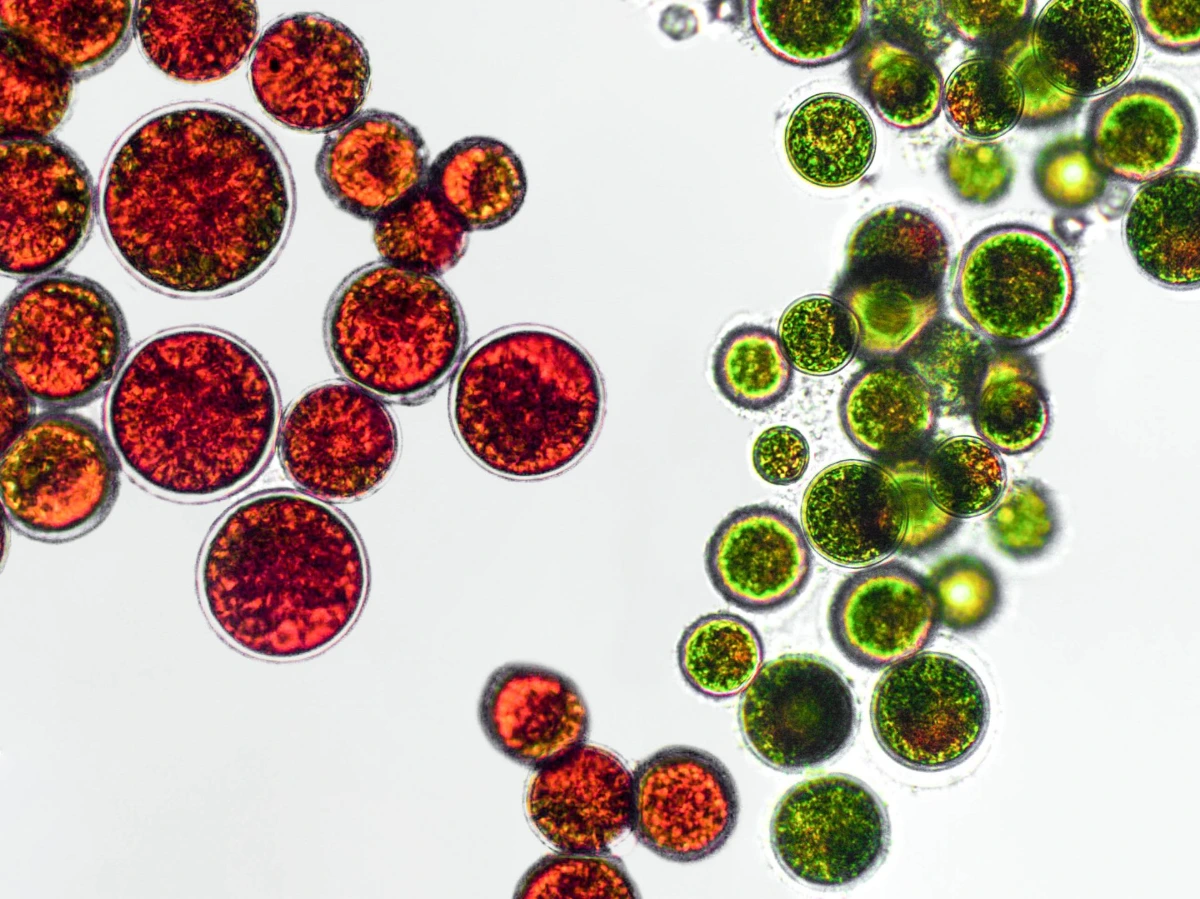
It is a red-orange carotenoid produced by the freshwater algae Haematococcus pluvialis. This algae does not live in ideal conditions. Think of intense sun, low nutrients, and strong temperature fluctuations. To protect itself, it produces astaxanthin.
That mechanism alone makes it interesting. Because although our skin is not in such an extreme environment, it does face a lot every day.
You also encounter astaxanthin in food. It is the reason why salmon and flamingos have their typical colour. But what happens at the cellular level is actually much more relevant than that colour.
In research, natural astaxanthin is often studied for its antioxidant properties. In certain contexts, it proves to be remarkably powerful, especially compared to more well-known antioxidants. That does not mean it replaces everything; rather, it can be an interesting addition.
What makes it particularly special is how it behaves within the cell. While many antioxidants are limited to one type of environment, astaxanthin can move through both water and fat-like structures.
Research on astaxanthin and the skin links to aspects such as elasticity, hydration, and how the skin responds to external influences. It is not about a single effect, but rather a combination of factors that together contribute to how the skin looks and feels.
Problem: the search for effective solutions for skin health.
For many people, it starts with small things. You look in the mirror and notice that your skin looks slightly different than it used to. Perhaps less even, or a bit less 'fresh'. Fine lines that you didn't notice before start to become apparent.
That process happens gradually. Often without you realising it, until it suddenly becomes visible.
External factors play a significant role in this. Sunlight is the most well-known, but air pollution, temperature fluctuations, and daily stress also have an impact. They accumulate, day after day.
Skincare helps to mitigate that impact. A good routine supports the skin barrier, helps protect against external influences, and contributes to how the skin looks and feels.
But at the same time, there is a growing awareness that skincare does not only happen on the surface. Continuous processes beneath the skin are at least equally important. Think of oxidative stress and how the skin renews itself.
That is why you are increasingly seeing a broader approach emerging. Not instead of skincare, but alongside it. As a complement.
Astaxanthin fits within that evolution. It does not focus on one visible problem, but on processes that are less tangible, yet have an impact on the overall picture.
The science behind the benefits of astaxanthin for the skin
The interest in astaxanthin does not come from nowhere. Quite a bit of research has been done on this antioxidant. We see three main effects:
Reduction of wrinkles and improvement of elasticity
Various studies have looked at how the skin responds to astaxanthin over a longer period.
What emerges from this is that changes usually occur gradually. After a few weeks, the skin is often perceived as slightly firmer. The elasticity increases, and fine lines, especially around the eyes, appear less pronounced.
These are not drastic differences from one day to the next. Rather, small shifts that together create a noticeable effect.
Fighting free radicals and supporting skin balance
Free radicals are constantly formed, influenced by factors such as UV radiation and pollution. This is a normal process, but when it becomes unbalanced, you see that reflected in the skin.
Astaxanthin plays a role here as an antioxidant. It helps to neutralise free radicals and thus supports the natural balance of the skin.
Because it can move across the entire cell membrane, it does not work in one specific place, but rather spreads out. This makes it different from many classical antioxidants.
Hydration and improvement of skin texture
Another aspect that often comes up is hydration. When the skin barrier functions well, moisture is better retained. You can see this in how the skin feels and looks.
Astaxanthin is linked in research to supporting that barrier. In practice, this often translates to skin that feels softer and looks slightly more even.
The same applies here: the effect builds up. Not suddenly, but gradually.
Expectations vs. reality: what research really shows
We have become somewhat accustomed to it: quick results, visible changes in a short time. But the skin does not work that way. On average, the skin takes about 28 days to renew itself. This means that everything you do, whether it is skincare or internal support, takes time to become visible.
Research on astaxanthin confirms this. In many studies, changes only become clear after six to eight weeks.
Additionally, your personal situation plays a significant role. Someone who has had a lot of sun exposure in the past will see different results than someone who has been less exposed.
Skin type also makes a difference. A dry skin reacts differently than an oilier skin.
What is clear is: the effect is not a “quick fix”. It is more something that builds up gradually.
Astaxanthin in your skincare routine
In practice, astaxanthin is most effective in products designed to protect the skin from sunlight. It plays a very specific role there.
When the skin is exposed to UV radiation, more happens than just the risk of burning. UV rays trigger a chain reaction that produces free radicals. It is precisely this oxidative stress that contributes to visible skin ageing, such as loss of elasticity and a less even skin texture.
Sun protection therefore forms the basis of every thoughtful skincare routine. Not only to protect the skin from UV rays in the short term, but also to limit the long-term impact.
Astaxanthin fits seamlessly into this. Within a sunscreen, it is added as an additional antioxidant, helping the skin cope with the oxidative stress that arises from exposure to sunlight. While UV filters focus on blocking or reflecting rays, astaxanthin plays a supportive role at the level of the skin itself.
Due to its unique structure, it can move across the cell membrane and contribute to neutralising free radicals. This makes it an interesting addition to sun protection, as it addresses what happens after the skin is exposed to UV.
In a daily routine, this concretely means that a sunscreen with astaxanthin does more than just protect against sun rays. It also supports the skin in how it reacts to that exposure.
Consistent use remains essential. Sun protection is not a one-time step, but something that recurs daily; especially when the skin is regularly exposed to sunlight.
By choosing a formula that combines UV filters with antioxidants such as astaxanthin, sun protection becomes a more layered approach: protection on the outside, with additional support at the skin level.
Astaxanthin is not a miracle cure, but certainly not a hype without basis.
What makes it interesting is the combination of properties: a strong antioxidant, a unique structure, and an effect that is not limited to one place.
The effects are not instant. They build up, step by step. It fits within a way of looking at skincare that goes beyond just what you see. More focused on balance, support, and long-term consistency.
About Tinge mineral sunscreens
Broad-spectrum protection: UVA, UVB, and blue light
Good protection against harmful radiation is essential for healthy skin.
UVB rays cause sunburn and direct skin damage. UVA rays penetrate deeper and play an important role in skin aging. They are present all year round and can cause damage without visible signs such as burning.
In addition, there is increasing attention for blue light, coming from both the sun and screens. This type of light can contribute to skin aging, inflammation, and pigmentation.
Therefore, it is important to choose a broad-spectrum sun protection that takes all these forms of radiation into account.
Different types of filters: chemical, mineral, and nano
Sunscreens protect the skin using chemical or mineral filters (nano/non-nano).
Chemical filters absorb UV radiation and convert it into heat. They protect the skin, but can cause irritation in sensitive skin types and are also being studied for their impact on the environment and potential hormone-disrupting properties.
Mineral filters, such as zinc oxide and titanium dioxide, work by reflecting UV rays. Tinge consciously chooses non-nano mineral filters, which remain on the skin and are not absorbed.
These filters provide effective protection against UVA and UVB rays and blue light, with a low chance of skin reactions and a limited impact on the environment..
Tinge therefore resolutely opts for 100% mineral sun protection with non-nano filters and natural astaxanthin.
We enrich our sunscreens with natural astaxanthin, a high-quality carotenoid complex from the microalga Haematococcus pluvialis, produced in Europe using the latest technology. This complex also contains other carotenoids that contribute to the antioxidant effect. Furthermore, the most powerful forms of astaxanthin have been selected. This results in a high-quality raw material that clearly distinguishes itself from other astaxanthin on the market.
→ Discover the Tinge mineral sunscreens SPF30 and SPF50+, with the addition of natural astaxanthin.